Beyond Brainstorming: Teaching Divergent Thinking Skills

Why Students Default to the “Safe” Answer
In 2010, teams at Google Ventures were facing a familiar challenge. Teams would spend weeks discussing ideas in meetings, but struggle to move from conversation to real solutions.
Jake Knapp, the co-founder of Google Meet, realized the problem wasn’t a lack of smart people or good ideas. It was the process. Traditional brainstorming often led groups toward the safest and most obvious answers rather than truly innovative solutions.
Sound familiar?
In classrooms, the same thing happens. Ask students for ideas, and you may hear crickets or receive generic, “safe” responses. When a student offers a safe answer or quickly Googles a solution, they aren’t necessarily being lazy. They’re using convergent thinking, searching for the single correct answer they believe the teacher wants.
But innovation requires something different: divergent thinking.
The Goal: Idea Volume
Divergent thinking focuses on generating many possibilities before choosing the best one.
Most students are trained to find the right answer as quickly as possible. That skill matters for math, grammar, and tests, but it can limit creativity when students are trying to solve open-ended problems.
First ideas are usually the most obvious, but when students push beyond those initial responses, they often begin to discover more unexpected and creative possibilities.
The goal of idea generation isn’t to be “right” immediately — it’s to be prolific.
The Photographer’s Mindset
One way to help students rethink idea generation is through what we call the Photographer’s Mindset.
A professional photographer doesn’t walk outside, take one photo, and call it a day. They take hundreds of shots to capture the one incredible image.
Creative thinking works the same way. The best ideas rarely appear first. They appear after many attempts.
To create that environment in the classroom, brainstorming sessions should follow a few simple rules:
The more ideas the better, so don’t limit your thinking
There are no bad ideas, so don’t judge yourself or others
Wild ideas are welcome, so use your imagination and dream big!
Record all you ideas so you can follow up on them later
When students know their ideas won’t be judged, they’re far more willing to contribute.

The Google Way to Spark Divergent Thinking: Crazy 8s
One popular ideation activity from the Google Ventures Design Sprint, created by Jake Knapp, is called Crazy 8s.
The exercise is simple, fast, and surprisingly powerful.
How it works:
Fold a sheet of paper into eight sections.
Set a timer for one minute per section.
Students sketch or write one idea in each square.
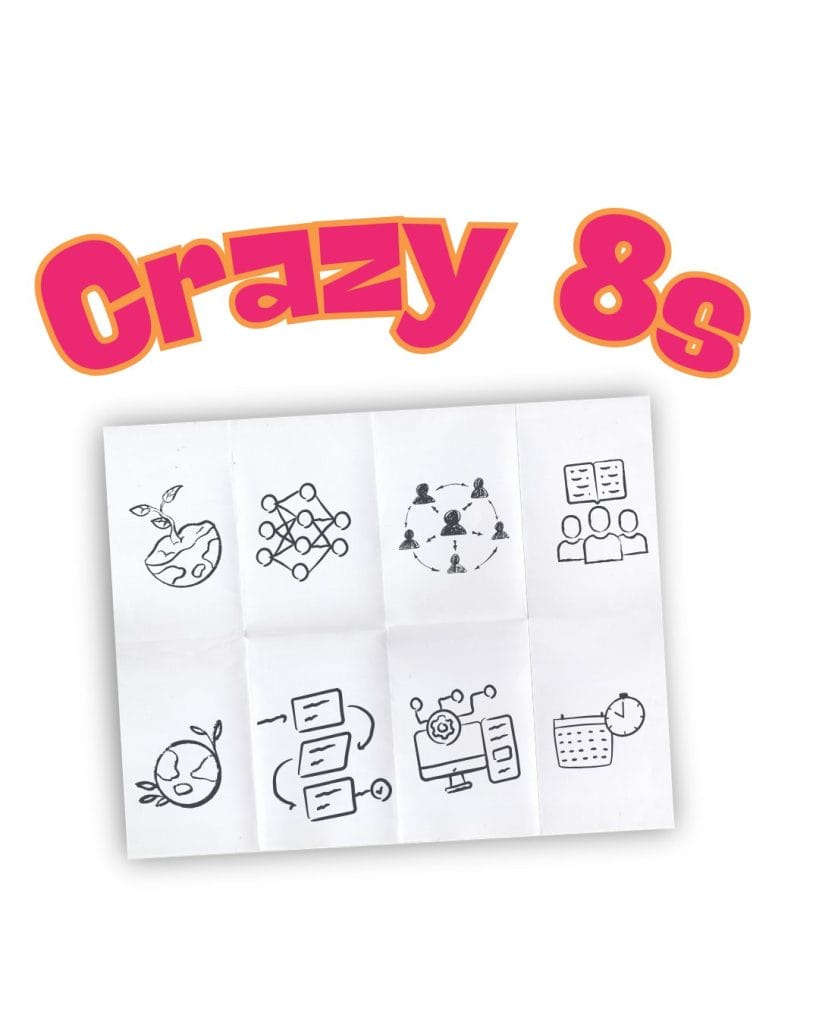
The time pressure forces students to move quickly. By the fifth or sixth square, their most obvious ideas are already gone — which pushes them toward more creative thinking.Activities like this help students experience an important lesson: great ideas often appear after the obvious ones run out.
A Simple 40-Minute Idea Sprint
Educators can combine these strategies into a short classroom innovation sprint:
1. Reframe the problem: Use a “How Might We” question.
Example: How might we make our school cafeteria zero-waste?
2. Generate ideas: Use Crazy 8s or another brainstorming activity.
3. Visualize solutions: Students create a quick three-panel storyboard:
Problem → Solution → Result -or- Observation → Opportunity → Outcome
4. Build a quick prototype: Using simple materials like cardboard, paper, and tape, students create a basic model to test their thinking
5. Pitch the idea: Students present their idea to the class by explaining why their idea is important and people need it.
For more ideas, check out the Stanford d.school Design Project Guide to discover how rapid prototyping and collaboration can transform your students’ creative confidence.
Creative Breakthroughs
We often talk about innovation as if it’s something that simply happens — a flash of brilliance or a lucky idea. In reality, creative breakthroughs usually follow a pattern: generate many ideas, build on them, test quickly, and learn from the results.
date published
Mar 15, 2026
reading time
5 min